Prospective home buyers and renters are familiar with the ritual of an open
inspection: wandering from room to room, taking in the overall feel, scrutinising a
few details, with one question looming over them: “how much will it cost to live
here?”
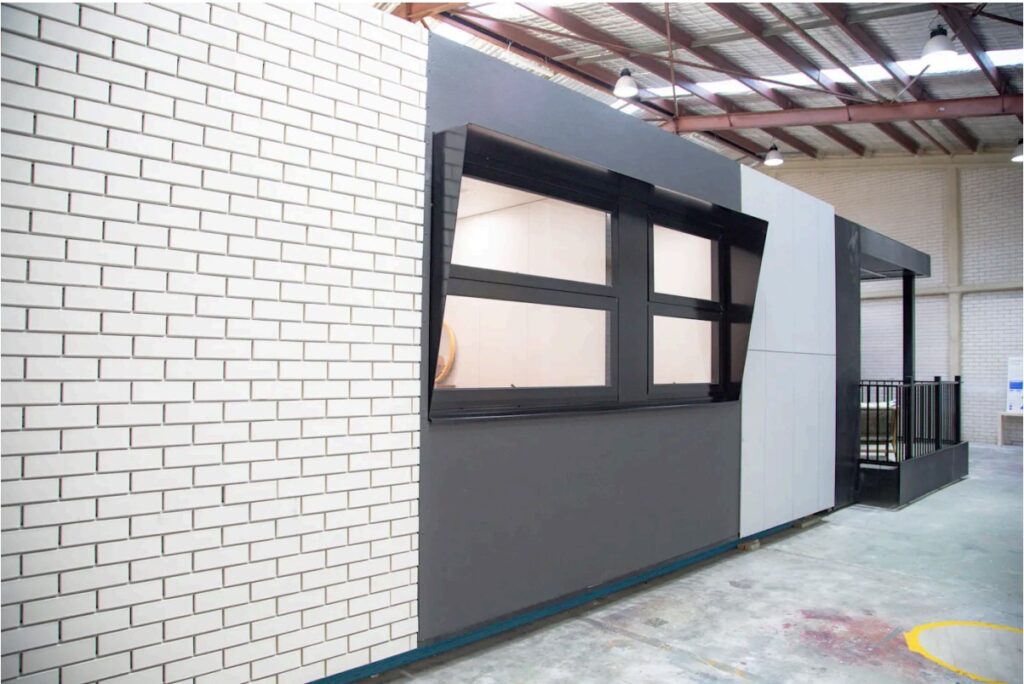
Those who inspected a “kit-of-parts” showcase home in Mascot, in Sydney’s south,
over the past three months asked a similar question, but with a twist: “how low can
construction costs go, if we built homes like this?”

Iris Celestine Tran Nguyen, co-founder of Aura Modular
The prototype on show is a kit home – a construction method in which designs act
as a platform for pre-manufactured, standardised parts that are assembled to
reduce construction time and costs.
It is one type of modern method of construction (MMC), an umbrella term that
encompasses non-standard builds, including modular homes. But unlike a
shipping container home assembled in one to four large sections, the kit home
consists of smaller parts.
A hot water system is rolled in on a rack that looks like it should house computer
servers; sections of wall and coverings fit together to make an apartment almost
indistinguishable from a traditional build.
The appeal is obvious: building costs have surged since the pandemic
[https://www.afr.com/policy/economy/building-costs-37pc-higher-than-four-years-ago-20240626-
p5jotu], exacerbated by material costs and a lack of tradies, and are now nudging
$5000 a square metre in Brisbane and Sydney
The showcase is put on by Homes NSW, which partnered with Building 4.0 CRC –
an industry-led research initiative co-funded by the federal government – to
investigate whether MMC could deliver more public housing for less.
Mathew Aitchison, chief executive of Building 4.0 CRC, says kit-of-parts will
improve the economics of prefab and modular housing, which is currently, in most
cases, more expensive than traditional building.
“That’s pretty tough because traditional building costs have gone up 65 per cent in
the last 10 years,” he says.
“How do we actually get the costs down? If we can have the most expensive part of
the building made en masse in a factory and wheeled in and plugged in – in the
space of 20 minutes as opposed to spreading that work out across weeks, and in
some cases months – that equates to a huge increase in productivity and
efficiency.”
Traditional construction is expensive because “we never have scale because
everything is done site by site, project by project”.
If the NSW government buys 4000 of a part one year, then 8000 the next, Wright’s
law – that costs decrease by roughly 20 per cent every time cumulative production
doubles – should apply, Aitchison says.
“We think 20 per cent cost reduction on the build and 20 per cent time reduction
[is achievable]. We expect over time that it would be 20 per cent cheaper than the
market rate.”
NSW Housing Minister Rose Jackson appears to endorse the claim, telling The
Australian Financial Review that “MMC means we can deliver high-quality homes
20 per cent faster than traditional methods without compromising on quality”.
“While MMC costs are currently comparable to traditional builds, scaling up will
drive prices down significantly.”
Jackson says the Minns government is “leading the way using MMC to take housing
delivery to the next level”. More than a quarter of the 8400 new social homes it is
delivering for $6.6 billion by 2031 will use MMC.
“Within five years, 80 per cent of our housing pipeline will use kit-of-parts
construction.”
Others are more sceptical. Brad Armitage, NSW executive director of the Housing
Industry Association, says the 20 per cent cost reduction claim is “grandiose” and
there is “no evidence to suggest it’s accurate”.
“There is some evidence that a kit-of-parts type approach would be more feasible
than a completely off-site manufactured home, but the market is not big enough to
validate that just yet. We’ve had businesses that do both go under, who haven’t been
successful.”
Armitage says the HIA wants the government to support the MMC part of the
industry but it’s “not the silver bullet it’s held up to be”.
Industry research suggests that, when farming land is rezoned as residential, it
takes 20 years for housing to be approved and finally to build a home. “Shaving four
to six weeks off the build time doesn’t add up where the majority of cost and delay
is in planning.”
Aitchison responds that 20 per cent “is not a retrospective claim”, so “no existing
dataset captures this specific system yet because it has not been implemented at
scale”.
‘I think it is ambitious’
Iris Celestine Tran Nguyen, co-founder of Aura Modular, imports modular homes
from Vietnam to build in remote locations, including Karratha. Nguyen attended
the Mascot showcase and is investigating the importation of kit-of-parts homes.
“If you say kit-of-parts homes are 20 per cent cheaper than traditional forms of
construction, I think it is ambitious,” she says. “I don’t say undoable, but it depends.
“Our modular houses work pretty well in remote areas where construction labour
costs are really high … We need to connect plumbing, [and] electrical. For kit parts,
it takes more time to assemble.
“One thing we can guarantee, with modular or kit parts, you can control
construction time: that is the advantage over traditional building.”
Homes NSW worked with Australian modular manufacturers to deliver its MMC
program, including NSW-based companies Wild Modular and Moov Modular.
But unions want local content rules in the National Construction Code to ensure
that, as MMC develops, jobs in the manufacture of kit parts and housing modules
are not offshored.
Australian Workers Union national secretary Paul Farrow says that “done right,
modular construction can help address our housing shortage while also creating
quality jobs in manufacturing”.
“Boosting modular construction in residential housing makes a ton of sense, and
we should be making sure this opportunity delivers maximum benefit for
Australian workers.
“That means any government-funded modular housing projects should have strong
local content requirements.”
Aitchison warns that importing parts comes with the risk of interruptions to
supply, shipping, and certification risks. He says there are “other ventures – not
ours – seeking to import large volumes of pre-manufactured buildings from
overseas, principally South-East Asia, like Vietnam, but also China”.
“That’s not what we’re trying to do. This is very much bottom-up, local industry
making parts, doing it more efficiently and more competitively.
“We do all of this to derisk the industry.”
https://www.afr.com//politics/this-home-came-in-kit-parts-could-it-save-20pc-on-a-new-build-20251103-p5n7bp?btis